
July 2026 Market Report: Abbotsford & Chilliwack
DEFINITIONS & METHODOLOGY
In this report, "Chilliwack" refers to Greater Chilliwack — East Chilliwack, Sardis, and Chilliwack proper combined into a single market using sales-weighted averages. This gives a fuller picture of the Chilliwack market than any single sub-area on its own.
All prices are 3-month rolling averages, weighted by sales volume, to smooth out the natural month-to-month noise in a market of this size. Months of Inventory (MOI), the key measure of whether conditions favour buyers or sellers, is calculated the same way: average active listings divided by average monthly sales over the three most recent complete months.
Market temperature is read as: 0 to 5 months of inventory, a Seller's Market. 5 to 8 months, a Balanced Market. Over 8 months, a Buyer's Market.
EXECUTIVE SUMMARY
Abbotsford and Chilliwack both sit in Balanced Market territory heading into August, though the two cities are telling slightly different stories. Abbotsford detached homes have tipped into Buyer's Market territory at just over 8 months of supply, while Chilliwack across every property type remains comfortably balanced and, in several segments, is showing more price resilience than its neighbour to the west.
The bigger story this month is not price, it is activity. July sales came in well below what this market normally produces in July, roughly half the 10-year norm in Abbotsford and about a third below normal in Chilliwack. Buyers have not disappeared, but many are choosing to wait, watch rates, and negotiate hard rather than compete. That combination, soft volume paired with only modest price movement, is the clearest sign yet of a market that has found a new, lower gear rather than one that is collapsing.
Zoom out and the picture is far less alarming. Despite the pullback of the last 14 to 18 months, detached home values in both cities have compounded at roughly 7 to 8 percent annually over the past decade. The current softness is a correction inside a longer uptrend, not a reversal of it.
MARKET GAUGE TABLE
The table below shows current Months of Inventory for each property type in both cities. Green (in the shaded chart on the following page) and blue tones signal a Seller's Market, amber signals Balanced, and red signals a Buyer's Market.
Months of inventory, 3-month rolling average, as of July 2026.
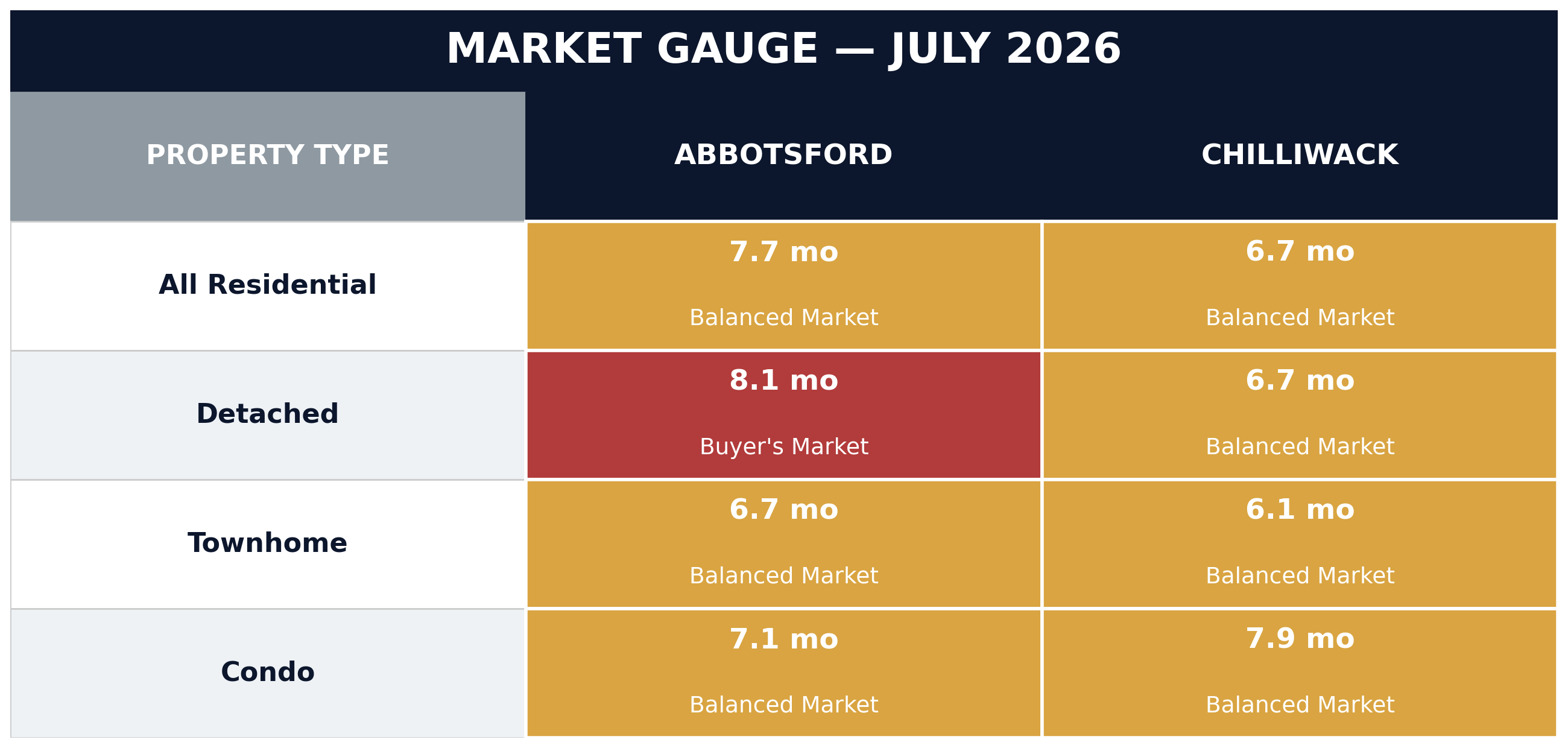
Every segment in Chilliwack, and three of four in Abbotsford, sits inside the Balanced range. The one exception is Abbotsford detached, which has drifted into Buyer's Market territory at 8.1 months of supply. Abbotsford condos, at 7.1 months, are close behind and worth watching. Chilliwack condos, at 7.9 months, sit at the balanced end of the range closest to a buyer's tilt.
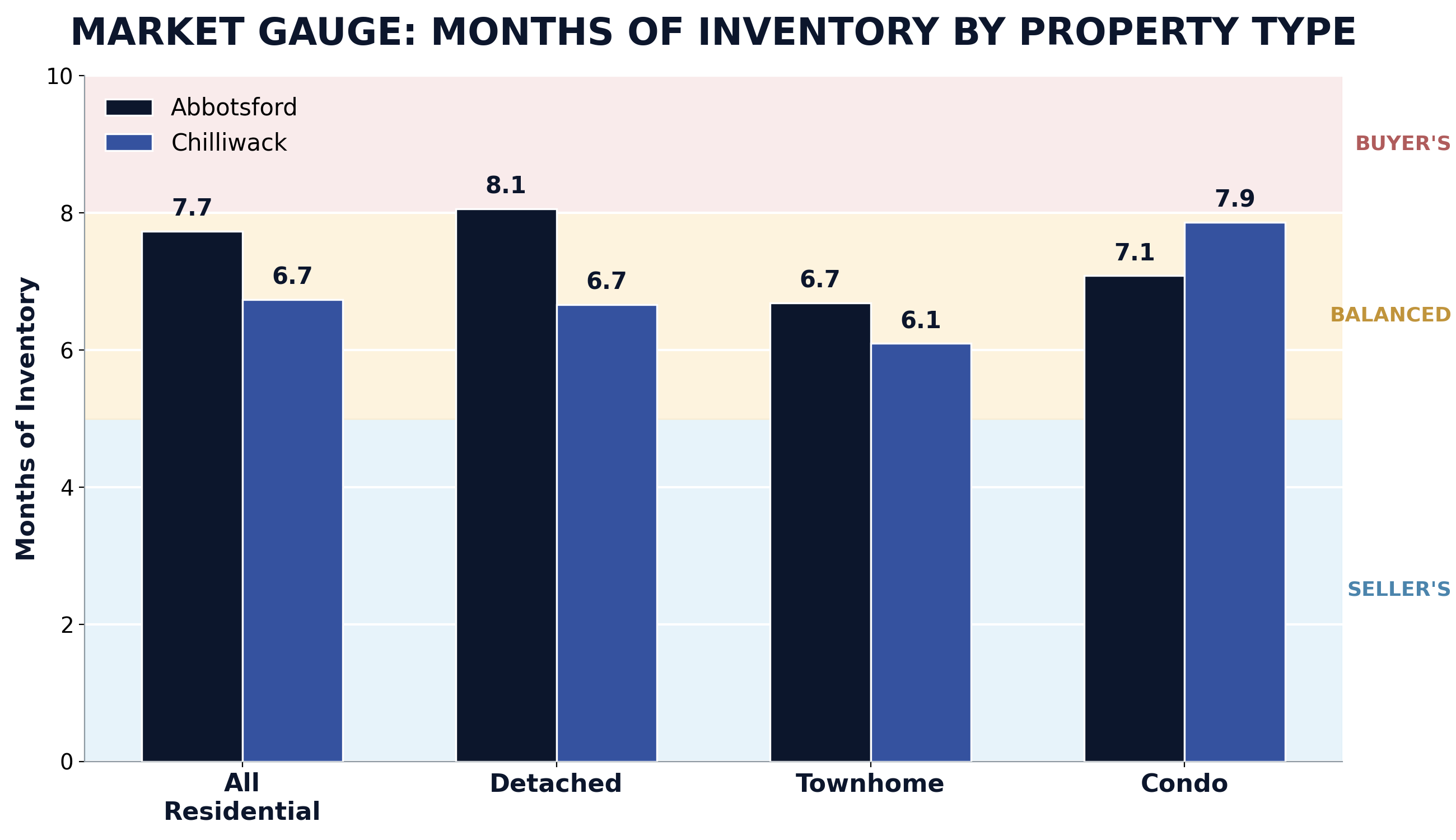
One nuance worth flagging: the inventory math says Balanced almost everywhere, but it will not feel that way to most buyers and sellers on the ground. With July transactions running well below normal (see What Prices Are Doing, below), the low number of buyers actually competing for each listing is giving this market more of a Buyer's Market feel than the Balanced label alone suggests.
WHAT PRICES ARE DOING
Looking at the most recent 3-month window (May through July) against the window immediately before it (February through April), prices are mixed rather than uniformly soft. Chilliwack posted gains across three of four property types, while Abbotsford saw small declines nearly everywhere.
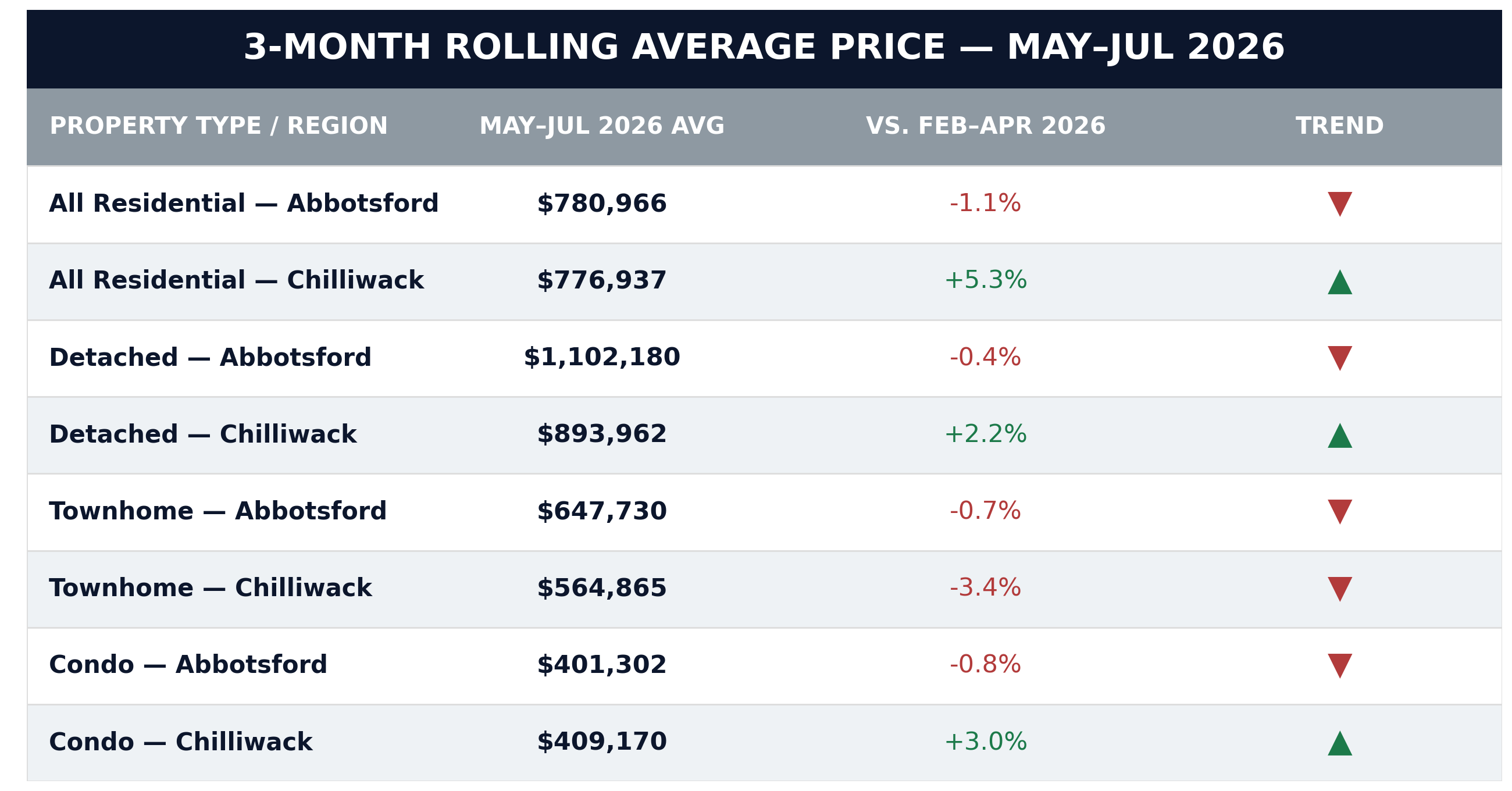
Zooming out further, most segments in both cities remain below the peaks they hit in 2024 and 2025. Abbotsford detached homes are down about 11 percent from their April 2025 high; Abbotsford condos are down a similar amount from their March 2025 peak. Chilliwack has held up somewhat better across the board, with detached homes down roughly 6 percent from their mid-2025 peak and condos down only about 4 percent from their summer 2024 high.
Sales Volume: The More Telling Number
Prices alone understate how quiet this market has been. July sales came in well under what the last decade would consider normal for the month.
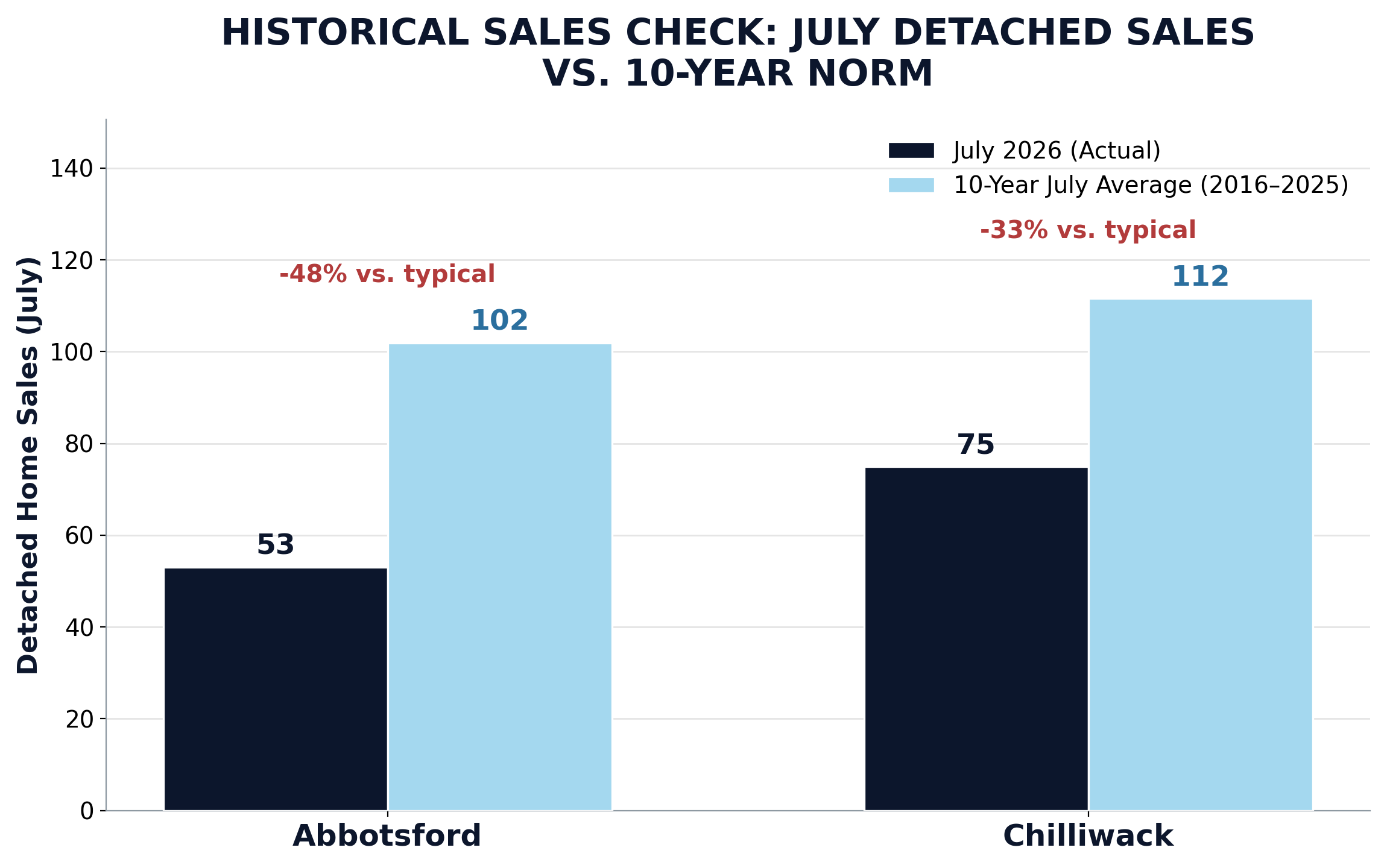
Fewer transactions with only modest price movement is a classic signature of a market where sellers are holding firm on price while buyers wait for more clarity on rates and their own finances. It also means listings that are priced realistically and marketed well stand out more than they would in a busier market.
UNDERSTANDING INTEREST RATES: FIXED VS VARIABLE
A lot of buyers mix these two up, so it is worth spelling out plainly. The Bank of Canada sets the overnight rate, which drives variable mortgage rates and the prime rate banks use for lines of credit. Fixed mortgage rates are driven by something different: the Government of Canada bond market, specifically the 5-year bond yield, which reflects what investors expect inflation and interest rates to do over the next several years.
The Bank of Canada held its overnight rate at 2.25 percent on July 15, 2026, the sixth consecutive hold, keeping the prime rate at 4.45 percent. The next scheduled decision is September 2, 2026. Meanwhile, the 5-year Government of Canada bond yield has stayed stubbornly elevated near 3.0 percent, which is why fixed mortgage rates have not fallen nearly as much as the Bank's extended pause might suggest.
As of early August, the best insured 5-year fixed rates were sitting around 3.9 to 4.0 percent, while the best 5-year variable rates were running lower, around 3.4 percent. That is an unusual gap. Variable is currently the cheaper starting point for buyers who can handle some payment movement, while fixed remains the choice for anyone who values a locked-in, predictable payment over the next five years.
Behind the elevated bond yields sits a Canadian inflation picture that improved in June but remains unsettled. Headline inflation cooled to 2.8 percent in June, down from a two-year high of 3.2 percent in May, largely on falling gas prices tied to a temporary ceasefire in the Middle East. That ceasefire has since broken down, and with it the risk that gas prices, and headline inflation, tick back up when July's numbers are released on August 17. The Bank of Canada is watching that risk closely, which is a large part of why it continues to hold rather than cut.
WHO THE MARKET IS BEST FOR
Conditions right now do not favour everyone equally. Here is an honest read on where each type of buyer and seller stands. Investors are covered on their own in Investor Insights, later in this report.
Downsizers & Empty Nesters
The one group that needs to go in with eyes open. Selling a larger detached home in Abbotsford right now means facing a genuine Buyer's Market, and detached values have given up more in real dollars than townhome or condo values have, down roughly $138,700 from last year's peak versus about $45,000 for townhomes and $54,200 for condos. That means net trade-down proceeds are smaller than they would have been at peak. The offsetting piece is the property you are moving into: townhomes and condos are trading in a softer, more negotiable corner of the market, so there is real room to negotiate on the buy side even while the sale side takes patience and realistic pricing. The transition still works, it just takes a more conservative number for what the current home will actually net.
Upsizers
A genuinely good window. Because detached prices have fallen further in dollar terms than townhome and condo prices in Abbotsford, the gap to move up has narrowed by roughly $85,000 to $95,000 since last year's peak. Add in a much quieter buyer pool, detached sales in Abbotsford are down roughly half from normal, and upsizers are facing far less competition bidding against them on the next home than they would have eighteen months ago.
First-Time Buyers
Among the more favourable positions right now, particularly in Abbotsford, where the numbers above already show less competition and more negotiating room. A variable rate that currently undercuts fixed adds to the case for a patient first-time buyer. The honest caveat: absolute prices remain high, detached homes in Abbotsford still average just over $1.1 million, and the mortgage stress test still qualifies borrowers at their contract rate plus 2 percent, so affordability remains the binding constraint for many.
A Few Things Worth Watching
None of the above changes the fact that this market carries some real near-term risk. The Middle East ceasefire behind June's inflation relief has already broken down; if gas prices climb back toward May's levels, expect a hotter July CPI reading on August 17 and a Bank of Canada that stays on hold even longer, keeping fixed rates sticky. And sales volume, not price, is the number to watch most closely over the next few months. If July's soft transaction count carries into fall, expect more price softening even where today's headline numbers look stable.
SPOTLIGHT A SEGMENT: CHILLIWACK DETACHED
If one segment deserves a closer look this month, it is Chilliwack detached homes. While Abbotsford detached prices sit about 11 percent below their April 2025 peak, Chilliwack detached homes are down a comparatively modest 6 percent from their June 2025 high, and the most recent 3-month window actually posted a gain of just over 2 percent against the window before it.
That relative resilience, combined with Chilliwack's comfortably Balanced 6.7 months of inventory (well inside the range, unlike Abbotsford's 8.1), makes it a market worth a second look for both buyers priced out of Abbotsford and sellers weighing where the next dollar of appreciation is most likely to hold.
STABILITY TREND
The chart below tracks detached home prices in both cities over the past 24 months, using the same 3-month rolling average as the rest of this report. Both markets peaked in the first half of 2025 and have eased gradually since, with Abbotsford showing a wider swing and Chilliwack tracking a flatter, steadier line throughout.
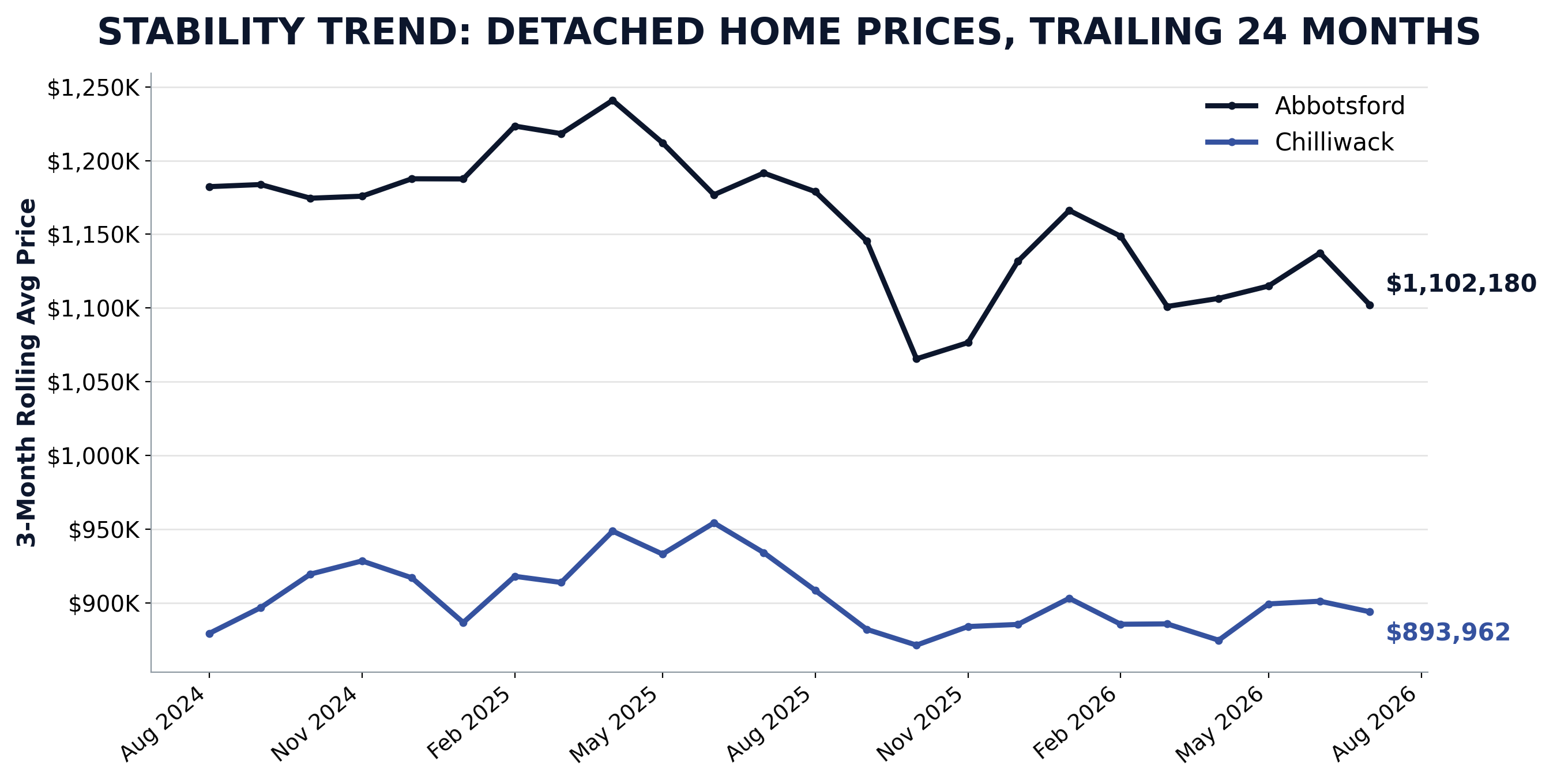
Neither city is in freefall. What the chart shows is a market cooling in an orderly way after a hot run, not a sudden correction. Chilliwack's narrower band of movement is consistent with its more affordable price point and steadier buyer base.
WEALTH TREND
Pulling back to a 10-year view puts the last year and a half of softening into perspective. Despite the recent pullback, detached home values across Abbotsford, Chilliwack, and Sardis have compounded at 7 to 8 percent annually since 2016.
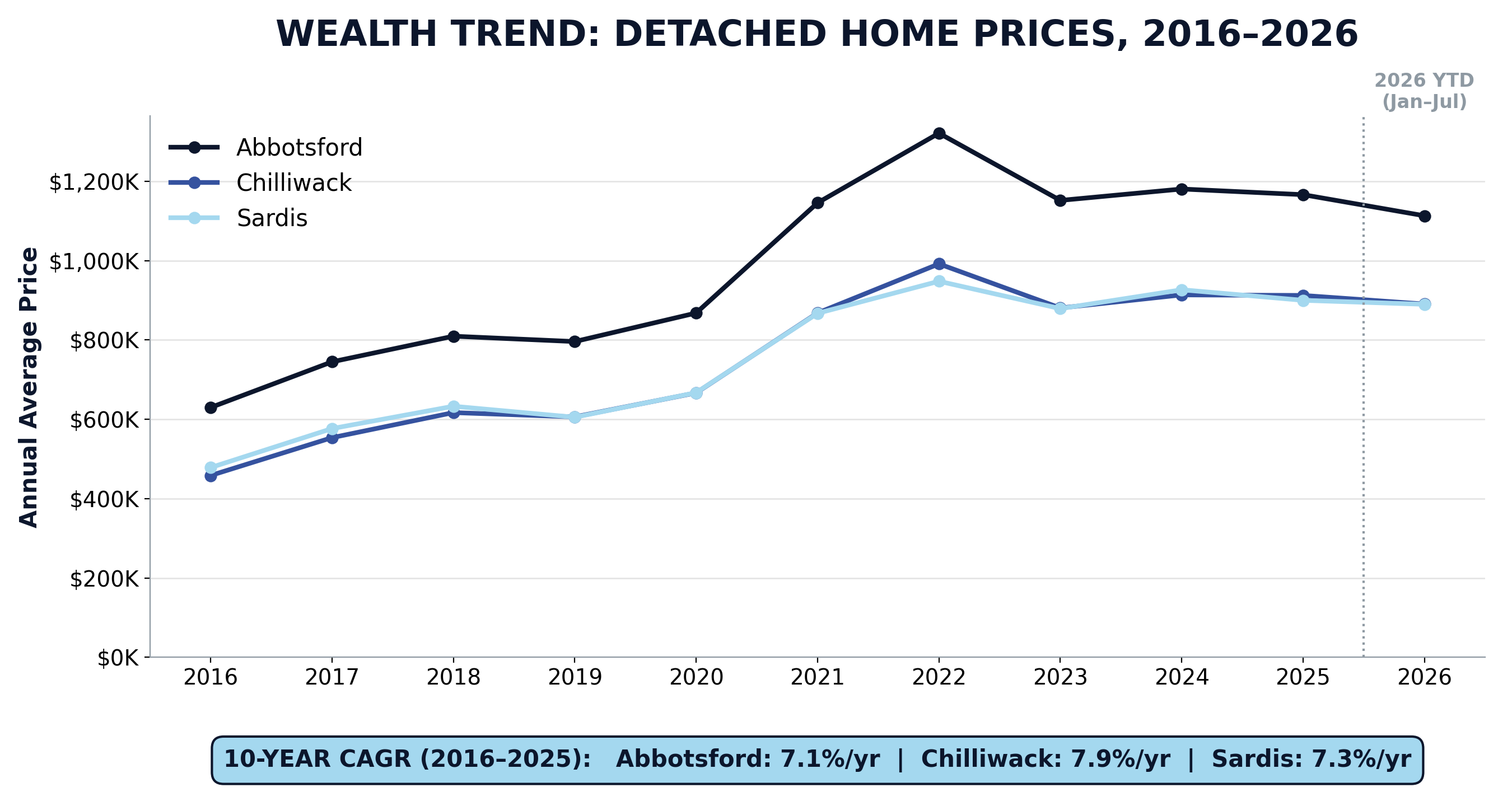
An owner who bought the average Abbotsford detached home in 2016 has still seen its value nearly double by today, even after the last year's decline from peak. For homeowners with a long time horizon, and especially for the empty nesters and downsizers this report is written for, the wealth-building case for real estate in this market remains intact. The last 18 months is a pause inside a much longer climb, not the end of it.
INVESTOR INSIGHTS: RATE SENSITIVITY & MARKET DYNAMICS
Investors weighing a purchase in this market need to separate two questions: what is happening to rental income today, and what is likely to happen to property values over the years they plan to hold. The answers currently point in different directions. The low transaction counts covered earlier in this report cut both ways here too, fewer buyers competing for a listing means more room to negotiate on the purchase, even in a market technically labeled Balanced.
Rental Market Conditions
CMHC's most recent survey put Metro Vancouver's purpose-built rental vacancy rate at 3.7 percent, more than double where it stood a year earlier and the highest reading since 1988. Asking rents in Vancouver have fallen roughly 9 percent year over year, the first sustained decline in years, driven by a wave of new rental supply, over 25,000 purpose-built units were registered across BC in 2025 alone, arriving just as demand from non-permanent residents and international students has pulled back sharply under new federal immigration targets. Fraser Valley communities like Abbotsford and Chilliwack are more insulated than Metro Vancouver given their lower price points and different tenant base, but the same directional pressure, more supply and softer demand, applies here too.
Where The Numbers Still Work
The negotiating room described above is opening up real opportunities for cash-flow-minded buyers at the right price point. A detached home with a secondary suite in the $800,000 range, the kind of property available in both Abbotsford and Chilliwack right now, or a suited townhome in Chilliwack closer to $700,000, can both pencil out well: the suite income helps carry a meaningful share of the mortgage, and softer competition on the purchase side means more room to negotiate the entry price than this market has offered in several years. These are illustrative price points rather than specific listings, and every property still needs its own numbers run before an offer, but they show the kind of math that is working right now.
Presale & Development Activity
Presale launches across the Fraser Valley and wider Lower Mainland have genuinely stalled, not just slowed. Industry tracker MLA Canada logged only 64 new presale homes across three projects region-wide in February 2026, about six percent of a typical month, capping what was already a decade-low year for launches in 2025. CMHC now expects more condo projects to be postponed or cancelled through 2027 and 2028 as financing gets harder to secure without strong presale commitments. The one relative bright spot: end-user-driven suburban markets like Abbotsford are expected to hold up better than investor-dependent urban markets, but developers everywhere are leaning hard on incentives, reduced deposits, and price adjustments just to keep the projects that are still moving forward on track.
Rate Sensitivity
With the Bank of Canada holding at 2.25 percent and the next decision not until September 2, financing costs for investors are stable in the near term but not falling quickly. Variable-rate financing at roughly 3.4 percent currently offers better carrying costs than fixed for investors comfortable with payment movement, which matters more than usual in a market where rental income is under pressure.
The honest takeaway: this is not a market for buying anything with a rental suite and assuming the numbers will work themselves out. Underwrite conservatively, use in-place or realistically achievable rents rather than 2022-era assumptions, and favour the segments and cities, Chilliwack over Abbotsford on a pure cash-flow basis, where entry prices and rents still pencil most consistently. Vacancy rates climbing this fast in the wider region rarely reverse quickly, so build in room for further softening rather than assuming today's rents hold.
MACRO OUTLOOK
The Bank of Canada is in an extended holding pattern, and the reasons why matter for anyone timing a purchase. Growth is picking up, inflation eased to 2.8 percent in June, and the Bank's own language describes an economy "showing signs of improvement." But the ceasefire that drove June's inflation relief has already broken down, and elevated oil prices tied to the ongoing Middle East conflict remain a real risk to the next few inflation readings. Until that risk clears, expect the Bank to stay cautious rather than move toward cuts.
Bond yields, and with them fixed mortgage rates, are likely to stay stickier than the overnight rate for the same reason. Even if the Bank eventually cuts, five-year fixed rates will only follow if bond markets believe the cut is durable.
The bigger structural story is demographic. Canada's population declined in the first quarter of 2026, the first such decline on record, driven by sharply reduced immigration and non-permanent resident targets. British Columbia posted the steepest provincial population decline in the country over the same period. That is a genuine headwind for housing demand at the national and provincial level. Fraser Valley communities have historically drawn a meaningful share of their growth from people relocating within BC, priced out of Metro Vancouver, which offers some insulation, but it is not immune to a slower-growing province.
Buying or Selling? Free home valuation and/or consultation
I look forward to working with you and helping you reach your home ownership goals. Reach out to get in touch and start the process today. I offer:
